
søndag 31. mai 2009
Two equally great, but very different books

Both of these share the top spot of my "most beautiful books to date" list, but in terms of style, genre and practically everything else they're very different.
"The secret history" is, roughly, a crime/mystery novel from an American university, its main characters a group of Ancient Greek students who get sucked into an entangled web of lies, drugs, homicide and ancient rituals. Two components make this the ultimate page-turner -
One: The extraordinary vivid description of characters. The author describes each character both psychologically and in terms of appearance (clothes, facial features, body language, quirks) in such detail that you can almost see them before your inner eye, like in a film. Gradually you begin to feel like you know them.
Two: The infinite amount of little details in the plot that leads to the explanation of other events, a skill only surpassed by that of Agatha Christie. The book keeps you constantly on your toes and, in a way, drags you along more or less against your will (at one point while reading it I was in a hurry and told myself I only had time to read one more page... then it was another page, then the rest of the chapter, then just another paragraph, and another....) When I had read the whole thing I was almost sad that it was over and that I didn't have that book to look forward to the next day.
"The invention of solitude" is also a page-turner in a way, though as a reader you don't get impatient to find out what's going to happen; there's no suspense as such. What stands out in this book however is the ability to move the reader; it's a very personal, vulnerable piece of work:
It's divided into two parts, the first called "Portrait of an invisible man" and the second called "The book of memory", both of which are autobiographical but the first more obviously so. Auster describes the circumstances of his father's death and also, inevitably, his father's life. The story also involves details about his father's childhood and the unusual events connected to his grandfather's death. "The book of memory" is written as a combination of a poetic piece of fiction and an essay, with references to everything from the Bible to Pinocchio. It's a little more "unstructured" than the first part of the book, but to me that's what makes it more poetic, and ultimately more personal. The perspective is no longer from a son's point of view but that of a father. He contemplates on the father/son relationships as they are described in literature, and shares memories from his own life, refering to himself as "A."
Out of the two parts, I find the latter the most moving; it's so vulnerable and honest and astonishingly beautiful. Especially at the very end where it's more or less dissolved into a poem; the last paragraph reads:
He finds a fresh sheet of paper. He lays it out on the table before him and writes these words with his pen.
It was. It will never be again. Remember.
Needless to say I highly recommend both of these books.

onsdag 8. april 2009
John Banville - Shroud
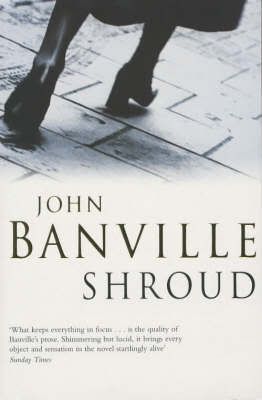 When I started reading this book I vaguely remembered that I'd made a start on it before - at the time I never made it past the first few pages. That's a mystery to me now, cause this time I fell instantly in love with it.
I'm so much of a language geek that I can read books solely for the way it's written, and not care too much for the story. In this case both the story and the way it was written appealed to me, but I will still say that the latter made the biggest impact - I actually found myself comparing it to having a sweet in your mouth and savouring it for as long as you can.
Upon reading the first few pages over again I'm willing to admit that perhaps the reason for my losing interest the first time was that you don't really get to know much about the story or the characters; you're sort of thrown into something and I suppose you have to like the mysterious, teasing style of it.
Even from the first two sentences it's clear that it deals with philosophical issues of existence and identity:
"Who speaks? It is her voice, in my head."
It doesn't get a lot more specific than that for a few chapters, and at that point there is a revelation that causes us to doubt everything we've already been reading; the slate is wiped clean again.
Without giving too much away I can tell you that the book is divided into three parts, the first of which serves as a sort of introduction. The main narrator is an elderly man by the name of Axel Vander, a Jew and survivor of World War II, then there is another female narrator called Cass Cleave, who has obviously discovered a truth about this man and is determined to meet him. We are constantly given vague clues about this secret, but never actually told what it is - until Axel, in the second part of the book, tells the whole story as it should have been from the beginning - the actual truth.
The third part contains narratives from both of them, and I felt a little disappointed by the ending, perhaps because the first two parts were so brilliant, or perhaps because I sometimes tend to read the end of the book faster than I read the beginning, and thus may miss details.
At first I thought "Shroud" was a strange title, but I suppose it sums up the book well. Not only because the Shroud of Turin plays a large part in the latter half of the book and it was obviously taken from there, but because reading the book evokes a feeling of seeing everything through a haze; always cloudy, vague, blurry - as readers we're being kept on our toes all the time. And it's not as frustrating as you may think.
torsdag 26. februar 2009
First book review & why blog about books
New blog, again? why, you say?
I have been extremely interested in books and reading since I was little. Going to the library was, for me, like going into a goldmine and coming out with my arms filled with treasures. I have been teased about it, I've even been ashamed about it at times cause at a certain age burying yourself in a book is not supposed to be your preferred pastime, but the last few years I've begun to kind of appreciate my appreciation for books and so I've started this blog where I can write about any book that I'm currently reading or have just read, books I've heard about but am not sure I will read, books that disappoint me or blow me away.

So I'm going to start off by writing about a book that did blow me away.
"Diary - A Novel" by Chuck Palahniuk
This has to be one of the strangest, most mesmerizing books I've ever read. It combines themes such as murder, fairytales, reincarnation, strange legends and failing relationships, into something that actually makes some kind of sense.
I would say though that the book's greatest strength is not only what it's about but the way it's written. There are chapters dedicated to each day, like a traditional diary, but every entry is written almost like a poem, with repetitions and short lines instead of long sentences with big words. Especially the repetitions help weave the whole story together as a complete, aesthetic piece of work.
I don't even know if I can explain in detail what the book is about, because a lot of it still puzzles me. (which I think is a good thing by the way) In short I can say it is about Misty Marie Kleinman, her husband Peter who's in a coma (after Misty found him in the car, presumably trying to kill himself), their daughter Tabbi and their life on the strange, fairytale-like Waytensea Island.
In itself that doesn't sound that confusing, but you don't have to dig much deeper before you begin to question the reality of it all. Like:
The Island is first described in Misty's drawing as a child; she could draw detailed houses and streets without having seen them and thus created a whole fantasy island in her mind out of her drawings, as way of escape from her tough childhood.
She has dreams of becoming an artist, and goes to art school, where she meets Peter - her future husband.
The book slowly and steadily reveals details of Misty and Peter's life together, and just as slowly and steadily you begin to realize that it is in fact the main story of the book and not just something that goes on in Misty's childish mind. But just when we feel "safe" and that we can grasp what the story is about, the author throws in more hints that we're just as clueless as when we turned the first page. Most of all the last page, after the story is finished - a letter from an unknown woman to the author, begging him to publish the manuscript she's enclosed. So not only are we to raise questions about things in the story itself, but also raise the question - who did actually write the book?
Rather than being frustrated about what I can't understand, I have to admire an author who manages to execute something so brilliant; a page-turner that raises questions about the existence of everything around us, without ever boring the reader.
I have been extremely interested in books and reading since I was little. Going to the library was, for me, like going into a goldmine and coming out with my arms filled with treasures. I have been teased about it, I've even been ashamed about it at times cause at a certain age burying yourself in a book is not supposed to be your preferred pastime, but the last few years I've begun to kind of appreciate my appreciation for books and so I've started this blog where I can write about any book that I'm currently reading or have just read, books I've heard about but am not sure I will read, books that disappoint me or blow me away.

So I'm going to start off by writing about a book that did blow me away.
"Diary - A Novel" by Chuck Palahniuk
This has to be one of the strangest, most mesmerizing books I've ever read. It combines themes such as murder, fairytales, reincarnation, strange legends and failing relationships, into something that actually makes some kind of sense.
I would say though that the book's greatest strength is not only what it's about but the way it's written. There are chapters dedicated to each day, like a traditional diary, but every entry is written almost like a poem, with repetitions and short lines instead of long sentences with big words. Especially the repetitions help weave the whole story together as a complete, aesthetic piece of work.
I don't even know if I can explain in detail what the book is about, because a lot of it still puzzles me. (which I think is a good thing by the way) In short I can say it is about Misty Marie Kleinman, her husband Peter who's in a coma (after Misty found him in the car, presumably trying to kill himself), their daughter Tabbi and their life on the strange, fairytale-like Waytensea Island.
In itself that doesn't sound that confusing, but you don't have to dig much deeper before you begin to question the reality of it all. Like:
The Island is first described in Misty's drawing as a child; she could draw detailed houses and streets without having seen them and thus created a whole fantasy island in her mind out of her drawings, as way of escape from her tough childhood.
She has dreams of becoming an artist, and goes to art school, where she meets Peter - her future husband.
The book slowly and steadily reveals details of Misty and Peter's life together, and just as slowly and steadily you begin to realize that it is in fact the main story of the book and not just something that goes on in Misty's childish mind. But just when we feel "safe" and that we can grasp what the story is about, the author throws in more hints that we're just as clueless as when we turned the first page. Most of all the last page, after the story is finished - a letter from an unknown woman to the author, begging him to publish the manuscript she's enclosed. So not only are we to raise questions about things in the story itself, but also raise the question - who did actually write the book?
Rather than being frustrated about what I can't understand, I have to admire an author who manages to execute something so brilliant; a page-turner that raises questions about the existence of everything around us, without ever boring the reader.
Abonner på:
Kommentarer (Atom)