
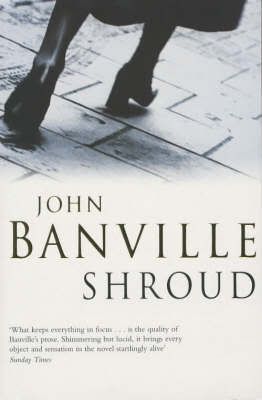
 When I started reading this book I vaguely remembered that I'd made a start on it before - at the time I never made it past the first few pages. That's a mystery to me now, cause this time I fell instantly in love with it.
I'm so much of a language geek that I can read books solely for the way it's written, and not care too much for the story. In this case both the story and the way it was written appealed to me, but I will still say that the latter made the biggest impact - I actually found myself comparing it to having a sweet in your mouth and savouring it for as long as you can.
Upon reading the first few pages over again I'm willing to admit that perhaps the reason for my losing interest the first time was that you don't really get to know much about the story or the characters; you're sort of thrown into something and I suppose you have to like the mysterious, teasing style of it.
Even from the first two sentences it's clear that it deals with philosophical issues of existence and identity:
"Who speaks? It is her voice, in my head."
It doesn't get a lot more specific than that for a few chapters, and at that point there is a revelation that causes us to doubt everything we've already been reading; the slate is wiped clean again.
Without giving too much away I can tell you that the book is divided into three parts, the first of which serves as a sort of introduction. The main narrator is an elderly man by the name of Axel Vander, a Jew and survivor of World War II, then there is another female narrator called Cass Cleave, who has obviously discovered a truth about this man and is determined to meet him. We are constantly given vague clues about this secret, but never actually told what it is - until Axel, in the second part of the book, tells the whole story as it should have been from the beginning - the actual truth.
The third part contains narratives from both of them, and I felt a little disappointed by the ending, perhaps because the first two parts were so brilliant, or perhaps because I sometimes tend to read the end of the book faster than I read the beginning, and thus may miss details.
At first I thought "Shroud" was a strange title, but I suppose it sums up the book well. Not only because the Shroud of Turin plays a large part in the latter half of the book and it was obviously taken from there, but because reading the book evokes a feeling of seeing everything through a haze; always cloudy, vague, blurry - as readers we're being kept on our toes all the time. And it's not as frustrating as you may think.
